
Discover Energy
How Electricity Reaches Your Light Switch
Press a switch on the wall, and the lamp comes on. What appears to be a small, instantaneous act is actually the visible tip of a vast, continent-spanning system. This is the story of how it works — running backwards from the bulb.
Reading time: about 11 minutes · From the Discover Energy series
The moment
It is a quiet evening. You walk into a room and press the switch on the wall. The light comes on.
In that fraction of a second between pressing the switch and seeing the light, something remarkable has happened — but not because one electron has crossed the continent. When you close the switch, the electric field in the circuit changes almost immediately and energy is transferred to the lamp. In an alternating-current system, the electrons already present in each wire mainly oscillate back and forth over very small distances; they do not travel from a distant power station to your room. Transformers make the distinction especially clear: energy passes from one circuit to another through electromagnetic fields, while the electrons remain in their own conductors. Almost everything that made this possible happened invisibly, and much of it long before you decided to walk into the room.
This essay traces the system backwards. We will start with the lamp, follow the building wiring, the streets, the substations and the high-voltage lines that connect regions and countries, and eventually arrive at the generators — and at the commercial and operational decisions that ensured enough generation was available at exactly the right moment. By the end, we hope you will look at a light switch differently.
The first wire: the local connection
The wire behind your light switch connects to a circuit running through the walls of your home. That circuit connects to a fuse box — the small grey panel usually tucked into a hallway or basement, with rows of switches you only notice when something has gone wrong. From the fuse box, a thicker cable runs outside the building, joining a network that runs under your street.
In most European cities, this local network — the distribution network — operates at relatively low voltages. Inside your home, the standard is 230 volts. On the streets, it rises to several thousand volts in the medium-voltage layer. The distribution network is operated by a regional or national company, typically called a Distribution System Operator (DSO). It is the part of the grid you experience most directly: if there is a local power outage because of a tree falling on a line or a transformer failing, this is the layer where the problem occurred. It is the part of the system that maintenance crews repair in the rain, in the middle of the night, while everyone else sleeps in the dark.
The distribution network is itself fed from a higher layer of infrastructure: the transmission network.
Going higher: the transmission network
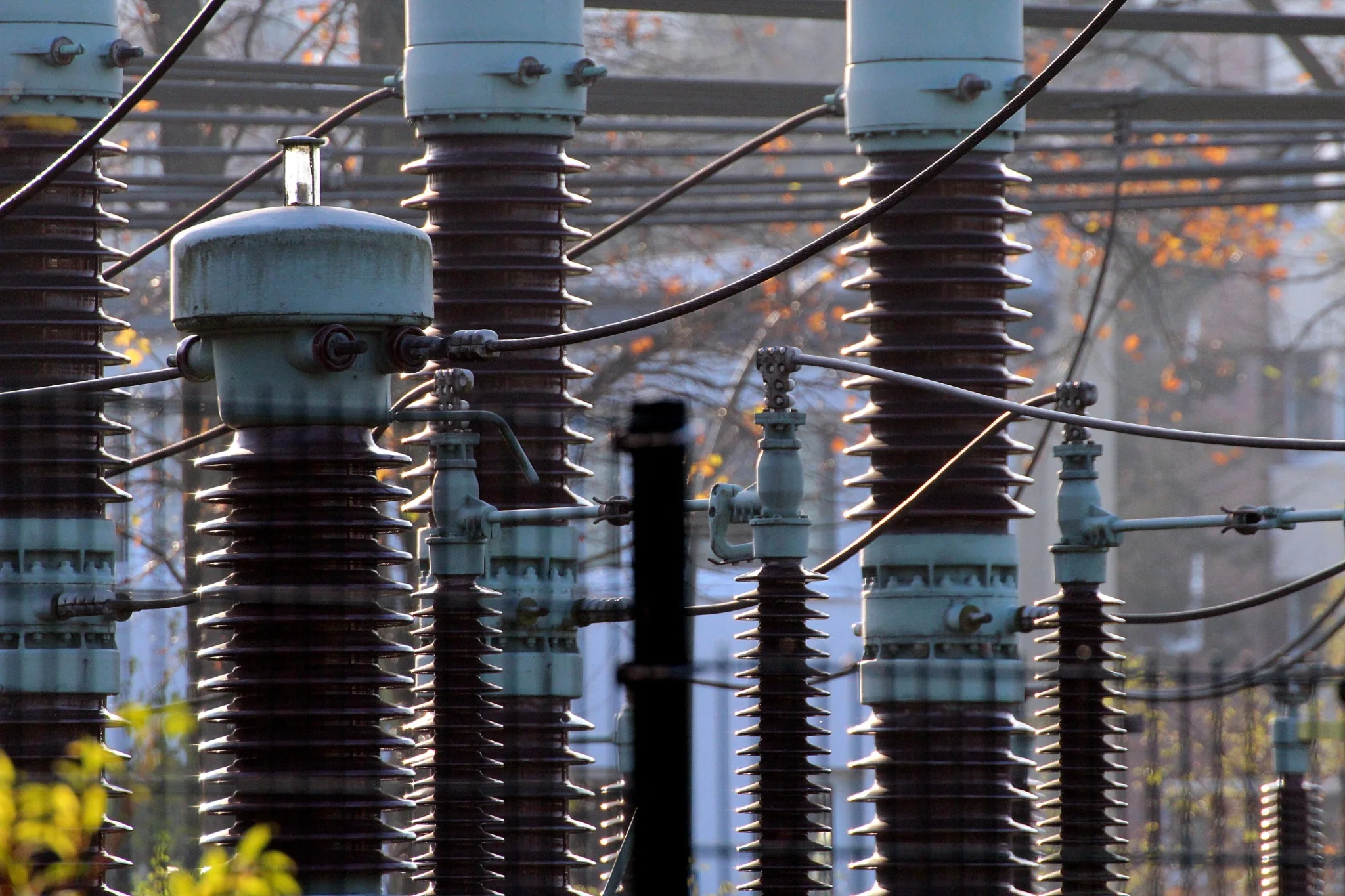
If you have ever stood near a high-voltage power line — the kind suspended on tall steel pylons that march across the countryside, sometimes humming faintly when the air is humid — you have seen the transmission network. These lines operate at very high voltages, typically between 110 kilovolts and 400 kilovolts. The reason is straightforward physics. At high voltages, electricity can be transported over long distances with relatively low losses, because the same amount of power flows with much less current. If you have ever wondered why high-voltage lines exist, the answer is essentially that they make long-distance electricity transport economically feasible.
The transmission network is the long-distance backbone of the electricity system. It connects power plants — large and small, conventional and renewable — to population centres, industrial facilities, and the regional distribution networks that serve households. In Europe, the transmission networks of different countries are interconnected. The Continental European synchronous area — which covers every market in which SANIA operates — stretches from Portugal to the Balkans and, since February 2025, to the Baltic states, running as a single system on a shared frequency; the Nordic countries, Great Britain and Ireland form separate synchronous areas, connected to it by high-voltage direct current links. This interconnection is one of the more remarkable engineering achievements in Europe — it makes it possible, in normal operation, for electricity generated in Spain to power a building in Slovakia, if economic conditions and physical capacities allow.
The transmission network is operated, in each country, by a Transmission System Operator (TSO). In Hungary, this is MAVIR; in Slovakia, SEPS; in the Czech Republic, ČEPS; in Germany, four regional TSOs share the responsibility; in Switzerland, Swissgrid. These organisations occupy an unusual position in the energy system. They are typically state-owned or strictly regulated. They do not buy or sell electricity for their own commercial account. But they are responsible — minute by minute, in real time — for ensuring that the network as a whole remains in balance.
A small but crucial fact: balance
Here is something most people do not know about electricity. In the form we use it, it cannot easily be stored at large scale. A battery can hold some, of course, and large pumped-hydroelectric facilities can hold more. But the total quantity of electricity in reserve across the entire European grid at any moment is small compared to the quantity being consumed every hour.
The implication is profound. At every moment, the amount of electricity being generated across Europe must equal the amount of electricity being consumed across Europe. Not approximately; precisely. If consumption exceeds generation, even slightly, the frequency of the grid begins to drop. If generation exceeds consumption, the frequency rises. If the deviation becomes too large in either direction, equipment connected to the grid begins to malfunction. In extreme cases, the entire system can collapse, leaving large regions without power for hours or days.
The TSOs are responsible for maintaining this balance. They do it by continuously monitoring the grid, adjusting which power plants are producing how much, and instructing flexible resources to start or stop on a moment’s notice. When you press your light switch and the lamp lights up, the demand from your bulb has just been added to the total European consumption. Somewhere, almost instantly, a generator has produced a tiny additional fraction of a kilowatt to balance it. Across the continent, hundreds of millions of similar small acts are happening every second, and the system absorbs them as a single continuous flow.
Where the electricity comes from
Now we have arrived at the source: the power plants.
European electricity comes from an extraordinary variety of sources. Nuclear power plants in France, Belgium, the Czech Republic, and elsewhere generate steady, low-carbon baseload electricity around the clock. Hydroelectric stations in Norway, Sweden, Switzerland, and Austria harness the energy of falling water. Wind turbines stand on the coasts of the North Sea and the Baltic, in the rolling fields of Germany and Poland, in the windswept hills of Spain. Solar farms cover the south of Europe, and millions of solar panels sit on the roofs of private homes from Lisbon to Tallinn. Gas-fired power plants provide flexible capacity when other sources are insufficient. Biomass, coal in declining proportions, and a small but growing fleet of battery storage facilities complete the picture.
When you pressed your light switch, the energy used by your bulb was supplied by the interconnected system as a whole, not by one traceable electron or one uniquely identifiable power plant. The generation mix supporting the system at that moment depended on the time of day, the weather, the season, prevailing fuel prices, and the operating decisions of power plant operators across the continent. On a windy, sunny Sunday afternoon, renewable sources may provide a larger share of that mix. On a still, cloudy weekday evening in February, nuclear and gas-fired generation may provide a larger share. The electricity at your socket carries no physical label of origin, but the changing generation mix affects both market prices and the carbon intensity associated with consumption.
Who decided the power plant should be running?
This is where the story gets less obvious — and more interesting.
Imagine the position of a power plant operator. Their plant can produce, say, five hundred megawatts of electricity. The cost of running it is not zero: there is fuel, maintenance, staff, capital cost. Whether it makes economic sense to run the plant at any given hour depends on whether the electricity it produces can be sold at a price above its cost of production. So at every hour, the operator faces a question: at what price can I sell my electricity right now, and is that price high enough?
This is where energy markets come in. Across Europe, there is a continuous process of price formation, in which buyers and sellers signal their willingness to transact at various prices for various time periods. The most important short-term market is the day-ahead market. Bidding closes at midday each day in an auction in which producers offer to sell electricity for each delivery period of the following day, and consumers (or the trading houses that represent them) bid to buy. The auction clears at the price where supply equals demand for each delivery period separately, and the resulting set of prices governs almost everything that happens the next day.
This is, in a real sense, how the system “knows” how much power to generate. The market price for the eight o’clock evening hour signals to power plant operators across Europe whether or not it is economically worthwhile to operate during that hour. Plants with low operating costs (nuclear, hydro, solar, wind) run almost regardless of price, because they always cover their costs. Plants with higher operating costs (gas-fired, coal-fired) only run if the price is high enough — and the price will be high enough exactly when the lower-cost sources are not sufficient to meet expected demand. The system organises itself.
But the day-ahead market is not the whole story. After the day-ahead auction, real-time conditions begin to deviate from forecasts. The wind may be stronger or weaker than predicted. A power plant may suffer an unexpected fault. Consumption may turn out higher or lower than anticipated. To handle these deviations, markets continue to operate. Intraday markets allow participants to adjust their positions hour by hour as new information arrives. Balancing markets allow the TSOs to procure the flexibility needed to keep the grid in real-time balance, second by second.
By the time you press your light switch on a Tuesday at 7:43 in the evening, the decisions about which generators would supply the system during that delivery period had largely been taken on Monday afternoon, refined throughout Tuesday, and adjusted again in the seconds around 7:43. All of this happened automatically, driven by prices that emerged from the collective decisions of thousands of market participants.
Who is in the middle?
Between the power plant and your light switch — between the producer and the consumer — sit a number of intermediaries. The TSOs we have already met: they operate the physical grid at the high-voltage level. The DSOs we have met too: they operate the local distribution networks. Retail suppliers — the company that sends you your electricity bill — buy electricity in wholesale markets on your behalf and resell it to you at a price that combines wholesale costs, distribution charges, taxes, and their own margin.
And then there are the energy trading houses. They sit in the wholesale market, providing liquidity, transferring risk, and helping the overall system function. A trading house may buy electricity from a wind farm operator who wants price certainty for the next twelve months, and then sell that same electricity, in a series of overlapping transactions, to an industrial consumer who needs predictable supply. It may notice that prices in one country are temporarily lower than in another and arrange for electricity to flow across the border. It may provide balancing services to a small renewable producer that cannot economically participate in the market on its own. SANIA Power AG is one such trading house, though far from the only one. Together, these firms form part of the invisible machinery that makes the modern electricity system economically viable.
A pause for wonder
Step back, for a moment, from the technical details. Consider what has actually happened in the time it took you to press the light switch.
A generation decision was made hours or days earlier, at a power plant possibly hundreds of kilometres from your home. Electrical power was generated, stepped up to high voltage, transported through transmission lines that crossed multiple national borders, stepped down through substations, distributed through the local network, and ultimately delivered through the wire behind your wall. All of this in a fraction of a second, with no advance notice that you were specifically about to press that switch, because the system is continuously prepared for the cumulative demand of hundreds of millions of people behaving roughly the way they typically behave.
The cost of doing all of this is, for an average European household, about 25 to 35 euro cents per kilowatt-hour — a price that includes everything from the original fuel, through the entire transmission and distribution infrastructure, to the taxes that fund national budgets and the margins that sustain commercial activity. For the energy itself, excluding taxes, network charges, and supplier margins, the wholesale cost in normal conditions is usually well under 10 euro cents per kilowatt-hour.
The lamp in your room consumes, perhaps, ten watts. To run it for an entire evening — say ten hours — costs you something on the order of three euro cents. To make those three cents possible, an entire continent’s worth of physical infrastructure, regulatory framework, market system, and human expertise has been working on your behalf — most of it quietly, most of it unnoticed, almost all of it taken for granted.
A modest hope
We hope this essay has done two things. First, we hope it has made the European electricity system visible to you — not in technical detail, but in outline, as a remarkable collective achievement. Second, we hope it has made the role of markets and trading less mysterious. Energy trading is not a remote financial activity, divorced from the physical reality of energy. It is, quite literally, the mechanism by which the physical system organises itself. Every megawatt-hour that reaches a light switch passes through the price signals and commercial decisions of the wholesale market.
If you found this essay useful, the other instalments of the Discover Energy series explore other dimensions of the same system. Why prices sometimes fall below zero on sunny Sundays. Why a cold Tuesday morning in Berlin matters across the continent. How the map of European gas was redrawn after 2022. The invisible market in carbon and green certificates. We hope you will read them.
For more technical depth on the European energy market structure, please see our European Energy Markets page. For the mechanics of trading itself, please see Energy Trading Explained.